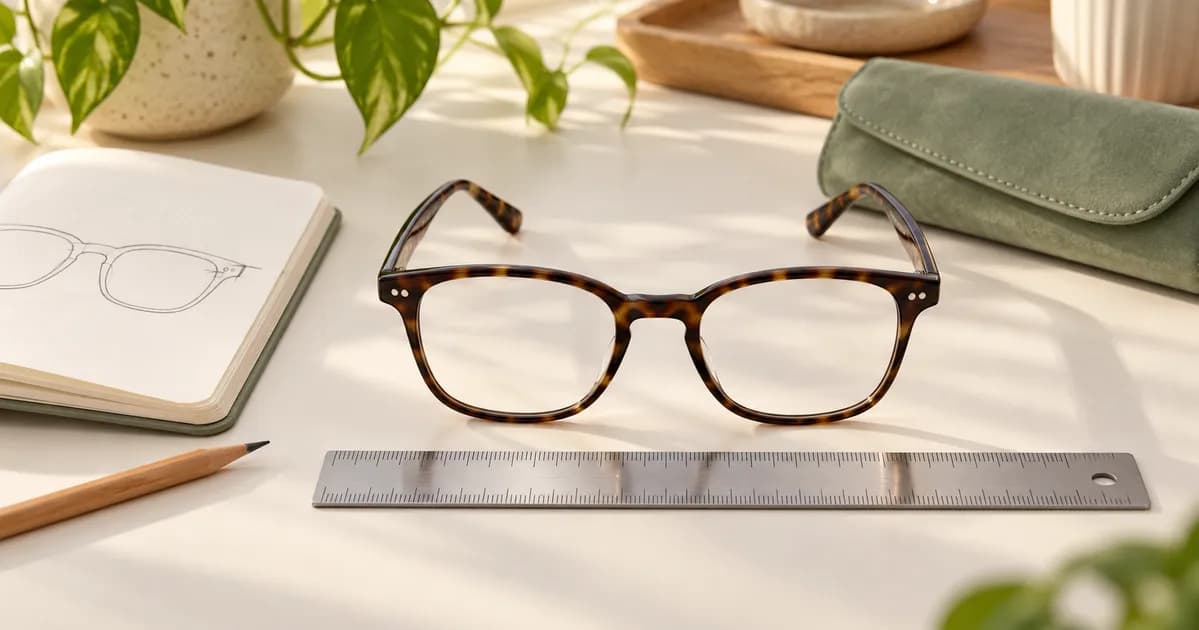
Buying glasses online becomes easier when you have a familiar pair to compare against. Before browsing frames at Lensmake or another eyewear store, take a few minutes to record the measurements of glasses that already feel comfortable.
You will need a ruler marked in millimeters, good lighting and somewhere to write your results. Home measurements are useful estimates for comparison; they do not replace a professional fitting.
Disclosure: This article is published by Lensmake, an online eyewear retailer, and was prepared with AI assistance.
1. Look for the size printed on your glasses
Check the inside of the temple arms and around the bridge. Alongside the model and colour codes, you may find a sequence such as:
52 □ 18 – 140
These numbers typically describe:
• 52: lens width in millimeters
• 18: bridge width in millimeters
• 140: temple arm length in millimeters
Write down the complete sequence. Do not assume that every number printed on the frame is a measurement—some identify the model or colour.
If the markings are clear, they provide a better starting point than trying to recreate the manufacturer’s measurements with a household ruler.
2. Estimate the width of one lens
Place your glasses on a soft surface and look straight at the front.
Measure horizontally across one lens opening at its widest point, excluding the surrounding rim. Keep the ruler level rather than following a diagonal across the lens.
Record the result in millimeters. Avoid pressing the ruler against the lens, where it could leave a scratch.
A home measurement may differ slightly from the printed size because the rim can conceal part of the lens edge.
3. Check the bridge measurement
The bridge connects the two lens rims above your nose.
For a rough comparison, measure the narrowest gap between the inner edges of the two lens openings. Use the printed bridge measurement when available, and check the retailer’s diagram to understand how its listed measurement is defined.
This number does not describe every part of nose fit. A moulded plastic bridge and a metal frame with adjustable nose pads can sit differently even when their stated bridge widths match.
Do not measure the width of your nose and assume it must equal the printed bridge size.
4. Estimate the temple arm length
Temple arms run from the hinges towards and behind your ears.
If the printed length has worn away, measure from the hinge to the start of the bend, then from the bend to the tip. Add the two measurements for an approximate length.
Do not straighten or force the arm to make measuring easier. Curved designs are difficult to measure precisely at home.
If you need an exact replacement size, ask an optician or the original manufacturer to help identify the frame.
5. Measure the overall frame width
Look at the frame from the front and measure horizontally across its outside edges at the widest point. Keep the ruler straight and note which endpoints you used.
Retailers may list overall width or hinge-to-hinge width. These are not necessarily identical, so compare your result with the measurement method shown on the product page.
Avoid calculating overall width simply by adding two lens widths and the bridge. That leaves out parts of the frame, including the rims and outer extensions.
6. Record what the measurements cannot tell you
Before choosing another pair, note how your current glasses actually feel:
• Do they stay in place when you look down?
• Do the sides feel comfortable?
• Does the bridge sit securely?
• Are the arms comfortable around your ears?
• Is the weight suitable for everyday wear?
Matching dimensions are a starting point, not a promise of identical comfort. Shape, materials, construction and adjustments also matter.
Keep a simple measurement record
Save a note containing:
• Frame brand and model, if known
• Printed size sequence
• Approximate overall width and measurement method
• What feels comfortable
• Anything you would like to change
Photographs of the markings and your ruler placement can help you explain a sizing question to the retailer.
Frame size is different from prescription information
Frame measurements describe the glasses themselves. They do not tell you your prescription or pupillary distance, commonly called PD.
Do not use the bridge number as your PD, or add frame measurements together to estimate it. Follow the retailer’s instructions for the information required for your order, and ask your eye-care professional when you need help.
Use your results to build a shortlist
Compare your notes with product measurements before deciding on a frame. When information is missing or measurement methods differ, ask the retailer for clarification.
If you do not already own a comfortable pair, an in-person fitting can provide a more useful starting point than guessing from photographs.
The aim is to make your comparison clearer—not to force a frame to work because its numbers look close.
Further reading
Warby Parker: Glasses Measurements
Zenni Optical: Size Tools and Measurements
About the author: Md Tauqueer Raza is a Shopify Developer at Lensmake. His work focuses on the brand’s online shopping experience.